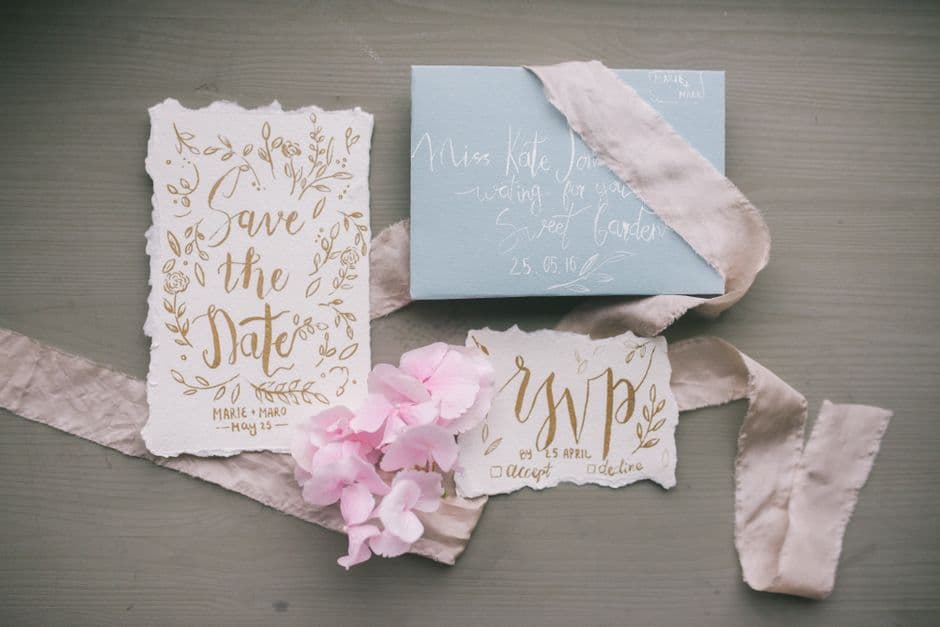
Your invitation is the first real glimpse guests get of your wedding, and stationery shows up again on the day itself, from the welcome sign to the place cards. It is also a project with hard deadlines, because paper has to be designed, proofed, printed, addressed and mailed. Knowing what you need and when it needs to go out takes most of the stress out of it.
What a stationery set usually includes
- Save-the-dates: an early heads-up with your date and location, especially helpful for out-of-town guests and holiday or peak-season weekends.
- The invitation: the main card with names, date, time and venue.
- Response card or online RSVP: a reply card with a stamped envelope, or a card pointing guests to your wedding website. Many couples now use a website RSVP, which makes tracking meal choices easier.
- Details card: the reception, accommodations, transportation, dress code and your website address, so the main invitation stays uncluttered.
- Envelopes: an outer envelope, sometimes an inner envelope or liner, plus the reply envelope.
- Day-of paper: welcome sign, programs, menus, escort or place cards, a seating chart, table numbers and signs for the bar or favors.
- Thank-you cards: often ordered in the same style to send after the wedding.
You do not need every piece. A small or casual wedding can skip programs and inner envelopes entirely, and an online RSVP can replace reply cards.
Printing styles and what drives the cost
- Digital or flat printing is the most affordable and fastest option, and works for most designs.
- Letterpress presses the design into thick paper for a tactile, debossed look.
- Foil stamping adds metallic or colored foil to names, borders or monograms.
- Engraving raises the ink from the paper for a very formal, traditional finish.
- Calligraphy, either on the design or for addressing envelopes, adds a handmade touch.
Custom design, specialty printing, thick or handmade paper, extra inserts, liners, wax seals and envelope addressing all add to the price, and so does a rush timeline. Fully custom and semi-custom options both exist, so ask what each studio offers. Browse invitation and stationery designers to compare styles, and see our vendor cost guide for how pricing works in general.
A mailing timeline
These are common guidelines rather than rules. Adjust them for your guest list and how far people are traveling.
- Six to eight months out: send save-the-dates. Go earlier for a destination wedding, a holiday weekend or a busy fall date in the mountains or at the coast.
- Three to four months out: finalize the invitation design and wording, and start addressing envelopes.
- Six to eight weeks out: mail invitations.
- Three to four weeks out: set the RSVP deadline here, so you have time to follow up with late replies before final counts are due to your caterer and venue.
- One to two weeks out: finalize the seating chart, escort cards and any day-of paper that depends on final numbers.
Leave time for proofs and printing, and add extra time if you are using a calligrapher. Our planning timeline shows how stationery fits with everything else.
Wording basics
- Lead with who is hosting, then your names, the date, the time, the venue and the city. A formal invitation spells out the date and time in words; a modern one may not.
- Put reception details, dress code and accommodations on a separate card or your website.
- Be clear about who is invited by how you address the envelope, and include the names of children who are invited.
- Proofread every name, date and address, then ask two other people to proofread again. A mistake caught at the proof stage costs nothing; one caught after printing costs a reprint.
Postage and mailing tips
Wedding invitations are heavier and less standard than ordinary mail, and that affects postage.
- Take one fully assembled invitation, with every insert, to the post office and have it weighed before you buy stamps.
- Square envelopes, very rigid envelopes, and envelopes with wax seals, ribbons or bulky embellishments often cost extra to mail because they cannot go through sorting machines.
- Ask the post office about hand canceling to reduce wear on delicate envelopes.
- Put the correct postage on reply envelopes, and include a return address on both the outer and reply envelopes.
- Order 10 to 15 percent extra invitations and envelopes for mistakes, late additions and keepsakes.
Ready to start? Browse stationery designers across the state, or vendors in Raleigh, Charlotte, Greensboro and Asheville. Our vendor checklist and budget guide will help you decide how much of your budget to give to paper.